
The Weapon the Church Didn’t Use:
The Threat of Excommunication
Papal apologists often dismiss excommunication as a powerful tool. Yet, the Catholic Church could have used it during the Holocaust to persuade the faithful from refraining to participate in any way in the persecution and murder of Jews. Apologists even claim that none of the Nazi leaders died as Catholics because they did not receive the sacraments during their political career. I think they are wrong, and they are misleading on both counts. The point is that these leaders were not expelled from the Church, and thus it is correct to state that they died as Catholics. Hitler even received a solemn requiem after he died. The Nazis, and particularly the SS may have tried to push Germans away from the church but the reality is that despite their strongest efforts, in December 1938 22.7% still remained in the Catholic faith and by 1940 over 95% of the German population were still tax-paying members of their respective Protestant or Catholic churches.

Gabriel Wilensky
Excommunicating a head of state might have been a dangerous or risky thing to do, but it was the right thing to do, particularly after 1942 when the extent and nature of the genocide became known to the pope and some members of the curia. Even though I think that excommunication would not have changed Hitler or his policies, I do think that excommunication of the entire Nazi leadership, in addition to the threat of excommunication to any Catholics involved in the business of mass murder, combined with strong, specific, and clear instruction to Catholics to refrain from denouncing, deporting and murdering Jews because it was a crime and a mortal sin, may have worked toward the goal of creating a moral revolt against genocide. Even if it had failed, it would have at least cemented the Church’s moral standing. In my opinion, it would have been particularly effective for the ordinary men in the factories making poison gas, or the train engineers taking Jews to the death camps, or the members of the killing squads and their helpers in Lithuania, the Ukraine, Poland, etc. who were killing hundreds of thousands of Jews in forests and ravines there. Or SS guards in the camps. These were not strongly anti-religious men like Bormann or Hitler. These were men who were going to Mass on Sunday and murdering Jews on Monday.
“Even though I think that excommunication would not have changed Hitler or his policies, I do think that excommunication of the entire Nazi leadership, in addition to the threat of excommunication to any Catholics involved in the business of mass murder, combined with strong, specific, and clear instruction to Catholics to refrain from denouncing, deporting and murdering Jews because it was a crime and a mortal sin, may have worked toward the goal of creating a moral revolt against genocide.”
For true believers in Christianity, whose church had been saying since the 15th century that there is no salvation outside the church, excommunication is an effective threat. If one truly believes in the teachings of the Church, then one must believe that if you are excommunicated and die, you won’t go to heaven. This would have been a frightening thought to a true believer, and in 1942 there were a lot more true believers in Europe than there are today. Sure, this would have been a laughable matter to Hitler but I seriously doubt the man driving the train to Auschwitz would have taken it that way. In any case, I think that what matters is also is in understanding in what way it was used by the Church. The Church used this weapon before and after the Nazi period, when it excommunicated all the communists in the world in one stroke. The Church never stopped using it because of fear. Even after Hitler came to power the strength and potential of the Church cannot and should not be underestimated. Just as the Catholic Germans were supportive of the Church’s admonition to stay away from the Nazis before the ban on membership in the Nazi party was lifted, they would have remained that way if the Church had continued to keep the ban in place or at the very least advised the faithful clearly, repeatedly and in no uncertain terms that the Nazi ideology was evil and incompatible with Catholic teachings. By not doing this the Church in essence told the flock that “Thou shall not kill” or “Do not do to others what you would not like to be done to you” did not apply to Jews.
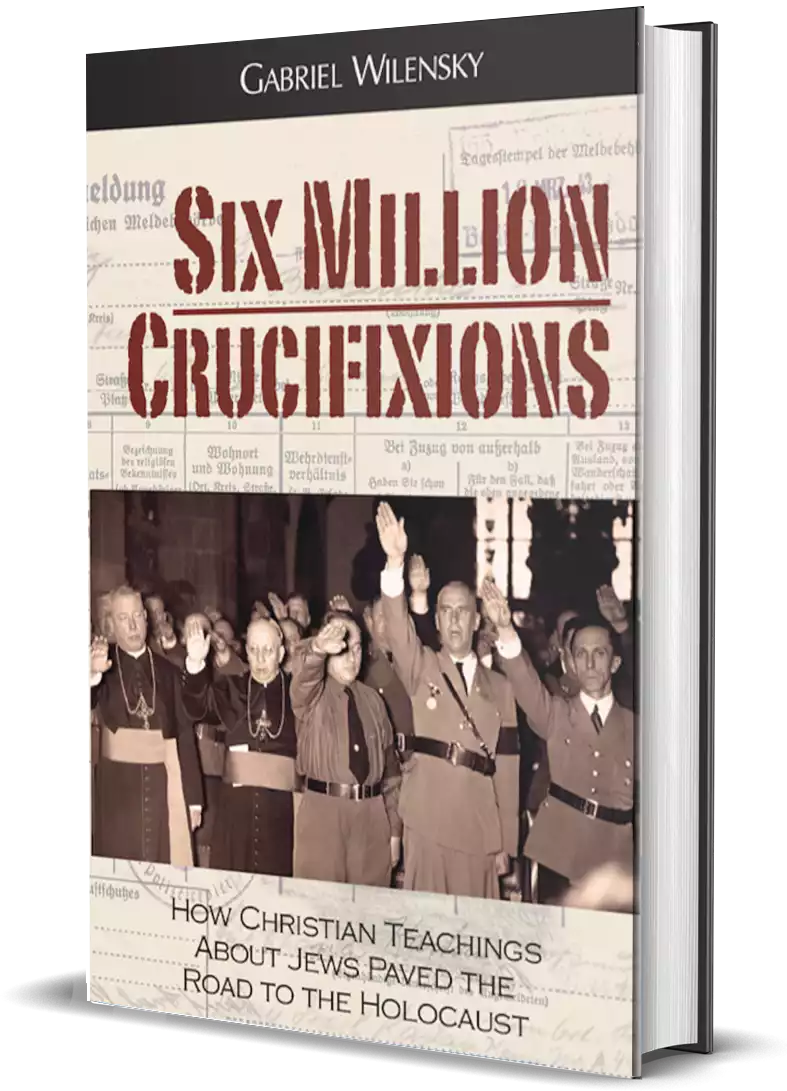
Grab Your Copy Today!
Six Million Crucifixions
Traces the history of antisemitism in Christianity and the role that played in making possible the Holocaust.
Want to stay informed about the topic?
Subscribe below.